

Selecting the right gas flow meter matters more than most procurement teams realize. A wrong choice costs you accuracy, drives up maintenance budgets, and can create compliance headaches in custody-transfer or billing applications. Two technologies dominate the conversation when engineers specify meters for natural gas, compressed air, and process gas lines: the vortex flow meter and the turbine flow meter.
This guide delivers a side-by-side gas flow meter comparison — covering working principles, accuracy specs, pressure drop, maintenance burden, and total cost of ownership — so you can make a confident, data-driven decision for your application.
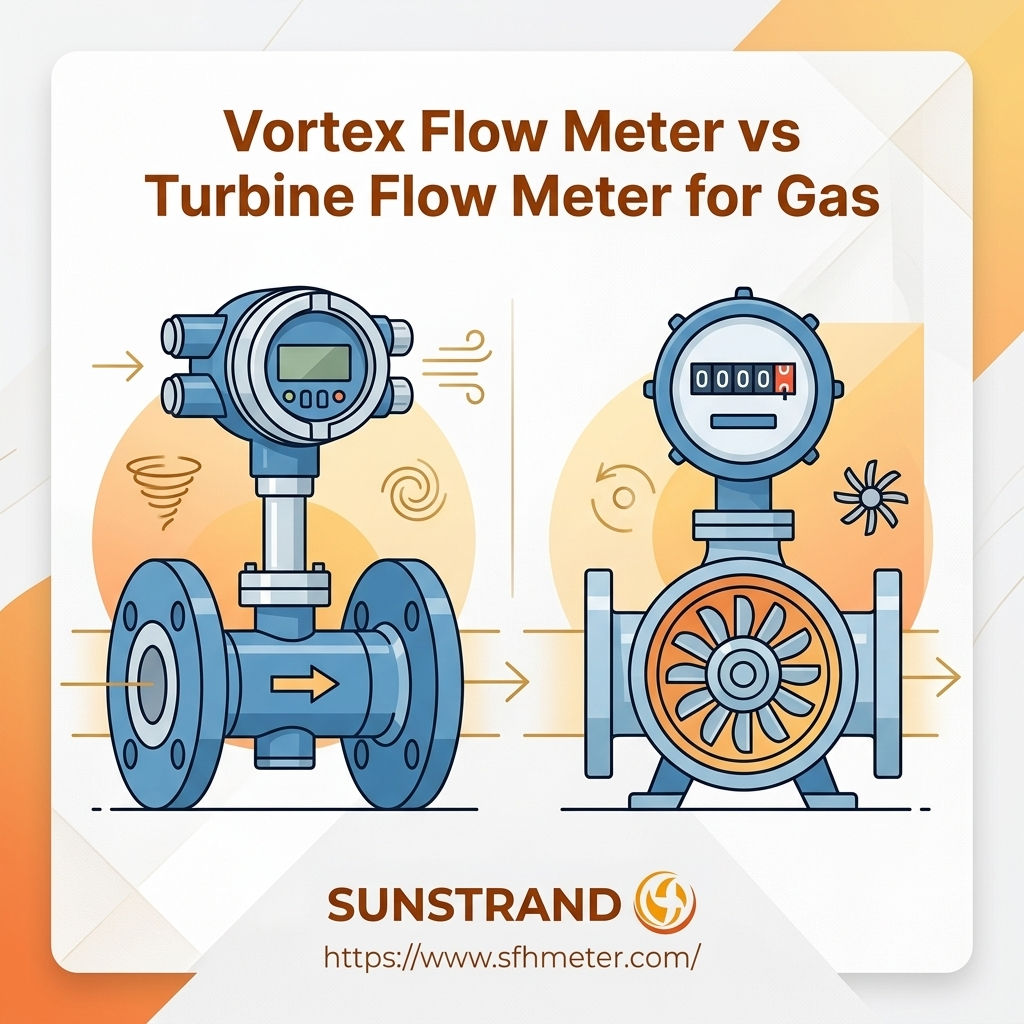
A vortex flow meter for gas exploits the von Kármán vortex-shedding principle. A non-streamlined bluff body is positioned inside the pipe. As gas flows through the meter, it creates alternating vortices downstream of the bluff body. The frequency at which those vortices shed is directly proportional to the flow velocity — the faster the gas moves, the higher the shedding frequency.
A piezoelectric or capacitance sensor detects these pressure fluctuations and converts them into a flow-rate signal. Because there are no moving parts, the design is inherently robust.
Key vortex flow meter applications in gas service:
A turbine flow meter for gas works on a straightforward mechanical principle. A multi-bladed rotor is suspended axially in the flow stream. As gas flows through the meter, the energy of the moving fluid spins the rotor. Rotational speed is directly proportional to the flow velocity, and a magnetic pickup converts each blade pass into an electrical pulse used to calculate volumetric flow rate.
Key turbine flow meter applications in gas service:
| Parameter | Vortex Flow Meter | Turbine Flow Meter |
|---|---|---|
| Working Principle | Vortex shedding from a bluff body | Rotor spin speed driven by fluid flow |
| Moving Parts | None | Yes — rotor and bearings |
| Accuracy (Gas) | ±0.75 % – ±1.5 % of rate | ±0.25 % – ±1.0 % of rate |
| Typical Rangeability | 20:1 for gas & steam | 10:1 – 20:1 |
| Pressure Drop | Low (~50 % of orifice plate) | Moderate — rotor creates back-pressure |
| Temperature & Pressure | Excellent high-temperature tolerance; stable across wide ranges | Accuracy affected by changes in temperature and pressure |
| Fluid Types | Gas, liquid, steam; handles some impurities | Clean, low-viscosity gas; not for dirty or wet gas |
| Maintenance | Minimal — no moving parts to wear | Regular — bearing inspection, lubrication, rotor replacement |
| Initial Cost | Medium–High | Medium (significantly cheaper than ultrasonic or Coriolis) |
| Long-Term TCO | Lower — reduced maintenance spend | Higher — ongoing bearing and rotor servicing |
| Low-Flow Performance | Cut-off at low Re; may not read below ~15 % of rated flow | Also limited below ~15 % of rated flow |
| Vibration Sensitivity | Moderate — signal filtering required in noisy environments | Low — mechanical design dampens pipe vibration |
| Custody Transfer (Gas) | Possible but less common | Widely approved (AGA, API MPMS Ch. 5.3, EN 12261) |
Accuracy is the most cited differentiator in any vortex vs turbine flow meter natural gas comparison, but the headline numbers need context:
For billing-grade or custody-transfer applications, turbine meters hold an edge. For process monitoring, energy sub-metering, or multi-fluid installations where steam and gas share the same meter family, vortex meters are typically the better choice.
There is no universal “best gas flow meter type” — the right answer depends on your specific operating context. Use this checklist:
| If your application requires… | Recommended Meter |
|---|---|
| Custody transfer / fiscal metering for natural gas | Turbine Flow Meter |
| High-temperature or high-pressure gas service | Vortex Flow Meter |
| Minimal maintenance / no moving parts | Vortex Flow Meter |
| Measuring gas, steam, and liquid with one platform | Vortex Flow Meter |
| Budget-sensitive clean-gas measurement | Turbine Flow Meter |
| CNG dispensing or natural gas billing | Turbine Flow Meter |
| Compressed air or HVAC energy management | Vortex Flow Meter |
| Mass flow measurement without external T/P transmitters | Vortex Flow Meter (multivariable) |
| Dirty or wet gas with contaminants | Vortex Flow Meter (avoid turbine) |
Vortex and turbine are the two dominant choices for gas, but engineers should be aware of the broader landscape when specifying meters:
The fundamental difference is mechanical design. A turbine flow meter uses a spinning rotor with moving parts; its rotational speed is proportional to gas velocity. A vortex flow meter has no moving parts — it relies on the frequency of vortices shed from a bluff body, which is also proportional to flow velocity. This makes vortex meters more durable but typically less accurate than turbine meters under ideal clean-gas conditions.
For custody transfer of natural gas, turbine flow meters are the established standard. They are approved under AGA Report No. 7, API MPMS Chapter 5.3, and EN 12261, and deliver accuracy within ±0.25 %–±0.5 %. Vortex meters can be used in fiscal measurement but are less widely certified for billing-grade applications.
Yes. Vortex flow meters for gas typically achieve ±0.75 %–±1.5 % accuracy across a wide flow range. For process control, energy monitoring, and non-custody gas applications, this level of accuracy is entirely sufficient. Multi-variable vortex meters with integrated temperature and pressure sensors can also output compensated mass flow, adding further value.
The primary cause is mechanical wear on the rotor bearings. As bearings wear, friction increases and the rotor spins more slowly for a given flow rate — causing the meter to under-read. Contaminated or wet gas accelerates this process. Regular bearing inspection and recalibration are essential to maintain turbine flow meter accuracy throughout its service life.
Yes. Vortex meters require a minimum Reynolds number (typically 10,000) to produce reliable vortex shedding. Below this threshold — which corresponds to roughly 15 %–20 % of the meter’s rated capacity — the output is clamped at zero. For gas applications with highly variable or low-flow conditions, carefully check the meter’s minimum measurable flow against your operating range.
Vortex flow meters have significantly lower maintenance costs over their operational life. With no moving parts, there are no bearings to inspect or lubricate, no rotors to replace, and no sensitivity to particulate-laden gas. Turbine meters require periodic bearing checks, lubrication (some models are self-lubricating), and eventual rotor replacement — all of which add up in long-term total cost of ownership.
No. Standard turbine flow meters cannot be used for steam measurement. The high-temperature, wet conditions of steam service would rapidly degrade the rotor and bearings. For steam, a vortex flow meter is the preferred choice — it tolerates saturated and superheated steam across a wide temperature and pressure range without mechanical degradation.
Both meter types introduce some pressure drop. Turbine meters tend to create higher back-pressure because the rotor physically obstructs the flow path — manufacturers recommend sufficient back-pressure to prevent cavitation. Vortex meters produce approximately half the permanent pressure loss of an equivalent orifice plate. In large-diameter, high-flow gas pipelines where energy cost is significant, the vortex meter’s lower pressure drop translates directly into operational savings.
A well-specified vortex flow meter can operate for 10–20+ years with minimal intervention, given clean installation and no process upsets. Turbine meters in clean-gas service typically last 5–10 years before bearing or rotor replacement is required; this interval shortens considerably with dirty or contaminated gas. Long-term reliability is one of the strongest arguments for vortex meters in remote or hard-to-service locations.
Choose a vortex flow meter when: (a) your gas may contain moisture, particles, or varying composition; (b) you need to measure both gas and steam with one meter family; (c) the installation is in a remote or high-maintenance-cost location; (d) your process involves high temperature or high pressure; or (e) you want to minimize lifetime maintenance spend. Choose a turbine flow meter when: custody-transfer accuracy is mandatory, the gas is clean and dry, and upfront cost is a primary constraint.
Both vortex flow meters and turbine flow meters are proven, cost-effective solutions for measuring the flow of gases in industrial settings. The decision ultimately hinges on three factors:
If you are still weighing options, consider discussing your specific operating conditions — flow rates, fluid composition, temperature and pressure range, and accuracy requirements — with a flow measurement specialist before specifying a meter.
Not Sure Which Gas Flow Meter Is Right for You?
Sunstrand’s application engineers review your gas type, flow range, and accuracy requirements — and recommend the right meter at no cost.
Or browse our full range of gas flow meters — vortex, turbine, electromagnetic, ultrasonic, and more.