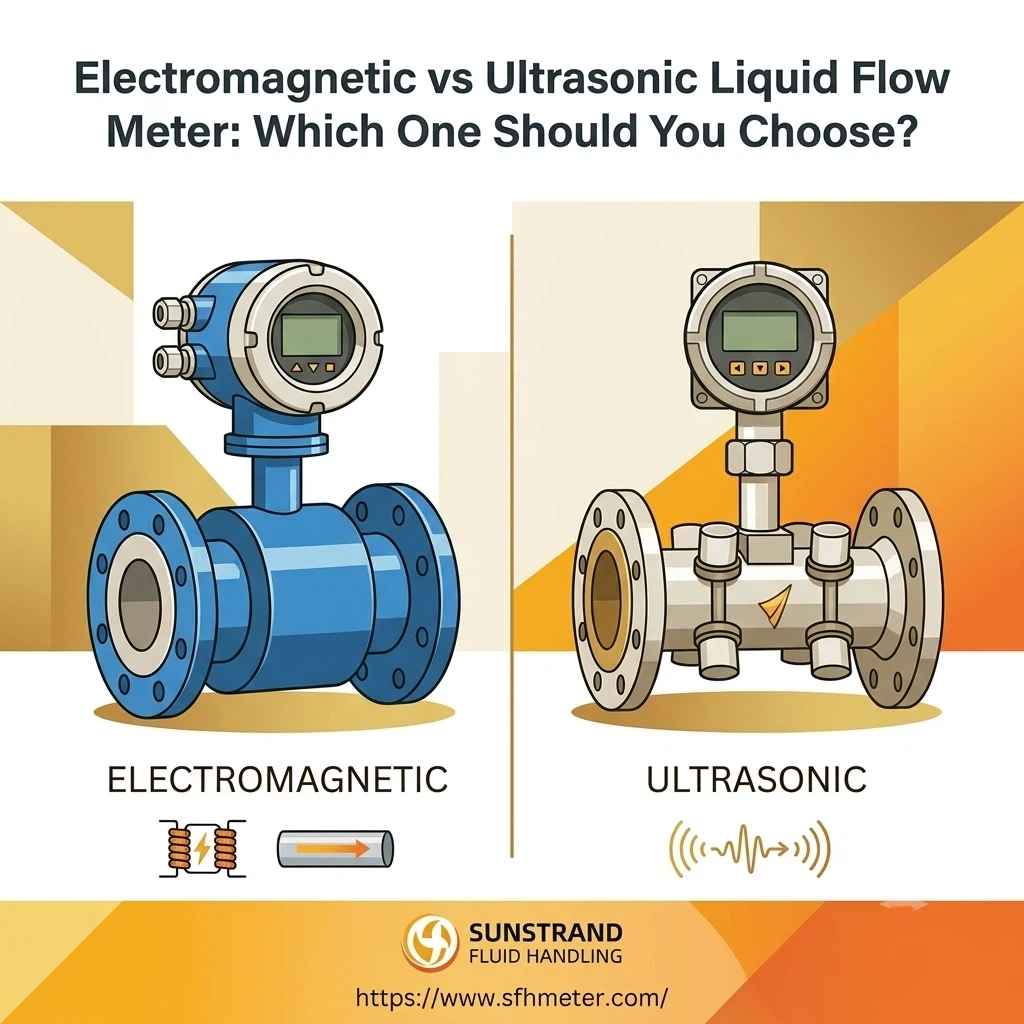


When specifying instrumentation for a new process line, one of the most common questions engineers face is: electromagnetic vs ultrasonic liquid flow meter — which one is right for this job? Both technologies deliver high accuracy without moving parts, yet they differ fundamentally in operating principle, fluid compatibility, installation method, and total cost of ownership. This guide cuts through the complexity so you can make a data-driven decision.
An electromagnetic flow meter (also called a mag meter or magmeter) operates on Faraday’s Law of induction. The meter generates a magnetic field perpendicular to the direction of liquid flow. As conductive liquid passes through that field, it produces a voltage proportional to flow velocity. Because the pipe’s internal diameter is known, the transmitter converts that voltage into an accurate volumetric flow rate—all without a single moving part inside the flow tube.
Key components include magnetic coils, electrodes mounted flush to the liner, a non-conductive flow tube liner, and a signal converter. The result: a clean, unobstructed bore that handles everything from clean water to abrasive slurries.
An ultrasonic flow meter uses high-frequency sound waves to measure liquid flow. There are two main variants:
Clamp-on ultrasonic meters mount externally, making them particularly useful for retrofits on existing pipelines where cutting the line is not practical.
| Comparison Factor | Electromagnetic Flow Meter | Ultrasonic Flow Meter |
|---|---|---|
| Operating principle | Magnetic field + induced voltage | Sound wave transit time or Doppler shift |
| Fluid requirement | Electrically conductive liquids (≥5 µS/cm) | Most clean liquids; also non-conductive fluids |
| Moving parts | None | None |
| Accuracy (typical) | ±0.2–0.5% of reading | ±0.5–1.0% of reading (clamp-on ±1–2%) |
| Slurries & solids | Excellent — handles heavy slurries | Poor for high solids content; can block signal |
| Non-conductive liquids | Not compatible (pure water, hydrocarbons) | Fully compatible |
| Installation type | Inline (wet, in-line installation) | Inline or clamp-on (non-invasive) |
| Pressure drop | Zero (full-bore design) | Zero (especially clamp-on) |
| Typical cost | Moderate (pipe-size dependent) | Moderate to high (clamp-on can be lower for large pipes) |
| Maintenance | Electrode cleaning may be required | Minimal; transducer coupling inspection |
| Best for | Water, wastewater, slurries, acids, bases | Hydrocarbons, pure water, food/pharma, HVAC |
Understanding electromagnetic flow meter advantages helps clarify when a mag meter is the superior choice:
The ultrasonic flow meter advantages are equally compelling in the right context:
Mag meters dominate wherever the process liquid is conductive and accuracy is paramount. Common electromagnetic flow meter applications include:
Ultrasonic technology is the preferred solution when the liquid is non-conductive, the pipeline cannot be interrupted, or hygienic contact-free measurement is essential. Key ultrasonic flow meter applications include:
The inline vs clamp-on flow meter decision often runs parallel to the electromagnetic vs ultrasonic choice, but they are not identical:
Electromagnetic meters are only available as inline instruments. If non-invasive installation is a hard requirement, ultrasonic clamp-on technology is the only option.
Use this quick flow meter selection guide framework before specifying any meter:
“Acoustic noise interferes with ultrasonic meters.” In practice, ultrasonic flow meters operate at ~1 MHz—far above the range of ambient plant acoustic noise—making interference extremely unlikely.
“Mag meters work on any water.” Distilled or deionized water has conductivity too low for reliable electromagnetic measurement. Even high-purity process water may fall below the minimum conductivity threshold.
“Clamp-on meters are only for temporary use.” Modern clamp-on ultrasonic meters with permanent transducer bonding (e.g., silicone coupling) are engineered for continuous, long-term installation.
1: What is the main difference between an electromagnetic and an ultrasonic flow meter?
An electromagnetic flow meter measures flow by detecting the voltage generated when conductive liquid moves through a magnetic field. An ultrasonic flow meter measures the transit time of sound waves through the liquid. The most practical difference: mag meters only work with conductive liquids, while ultrasonic meters can measure both conductive and non-conductive fluids.
2: Can a mag meter measure pure water or distilled water?
No. Pure water and distilled water have electrical conductivity below the minimum threshold (~5 µS/cm) required for electromagnetic measurement. A transit-time ultrasonic flow meter is the correct choice for these fluids.
3: Which flow meter is more accurate—electromagnetic or ultrasonic?
Inline electromagnetic and inline transit-time ultrasonic meters offer comparable accuracy at ±0.2–0.5% of reading under ideal conditions. Clamp-on ultrasonic meters typically achieve ±0.5–2% accuracy due to signal attenuation through the pipe wall. For custody-transfer applications, inline electromagnetic meters are often preferred.
4: Can I install an ultrasonic flow meter without cutting the pipe?
Yes. Clamp-on ultrasonic flow meters attach to the outside of the pipe with no cutting, welding, or process shutdown required. This makes them ideal for retrofits, energy audits, and applications where flow measurement needs to be added to an existing live pipeline.
5: What happens if there are air bubbles in my ultrasonic flow meter?
For transit-time ultrasonic meters, air bubbles scatter the sound signal and can cause inaccurate or unstable readings. Solutions include installing the meter on a vertical pipe section, fitting an upstream strainer, or choosing a Doppler-type ultrasonic meter, which actually relies on entrained bubbles or particles to generate a signal.
6: Are electromagnetic flow meters suitable for slurry applications?
Yes. The full-bore, unobstructed design of a mag meter makes it well-suited to slurries, sludge, pulp, and liquids with high suspended solids content—provided the carrier fluid is electrically conductive. This is one of the key electromagnetic flow meter advantages over transit-time ultrasonic technology.
7: Which flow meter type requires less maintenance?
Both are low-maintenance instruments. Mag meters may require periodic cleaning of electrodes if scale or mineral deposits build up. Clamp-on ultrasonic meters have essentially zero wetted components, but the acoustic coupling between transducer and pipe should be inspected periodically to ensure signal quality is maintained.
8: Can electromagnetic flow meters measure flow in both directions?
Yes. Most modern mag meters support bidirectional flow measurement, making them suitable for batch processes, return loops, and any application where flow direction can reverse.
9: How do I choose between a clamp-on ultrasonic and an inline electromagnetic meter for a water application?
If the water is conductive (municipal or process water with normal mineral content), accuracy requirements are high, and permanent installation is acceptable, choose an inline electromagnetic meter. If the pipeline cannot be shut down, pipe diameter is large, or a temporary/portable measurement is needed, a clamp-on ultrasonic meter is the practical choice.
10: What is the typical lifespan of an electromagnetic vs ultrasonic flow meter?
Both technologies are engineered for long service life—typically 10–20 years with proper installation and maintenance. Mag meter liner life can be affected by highly abrasive or chemically aggressive media if the wrong liner material is specified. Ultrasonic meter transducer life depends on whether they are wetted (inline) or externally mounted (clamp-on).
Sunstrand’s engineering team helps B2B buyers specify the right flow meter—electromagnetic or ultrasonic—for their exact application, fluid type, and budget. Get a free technical consultation today.